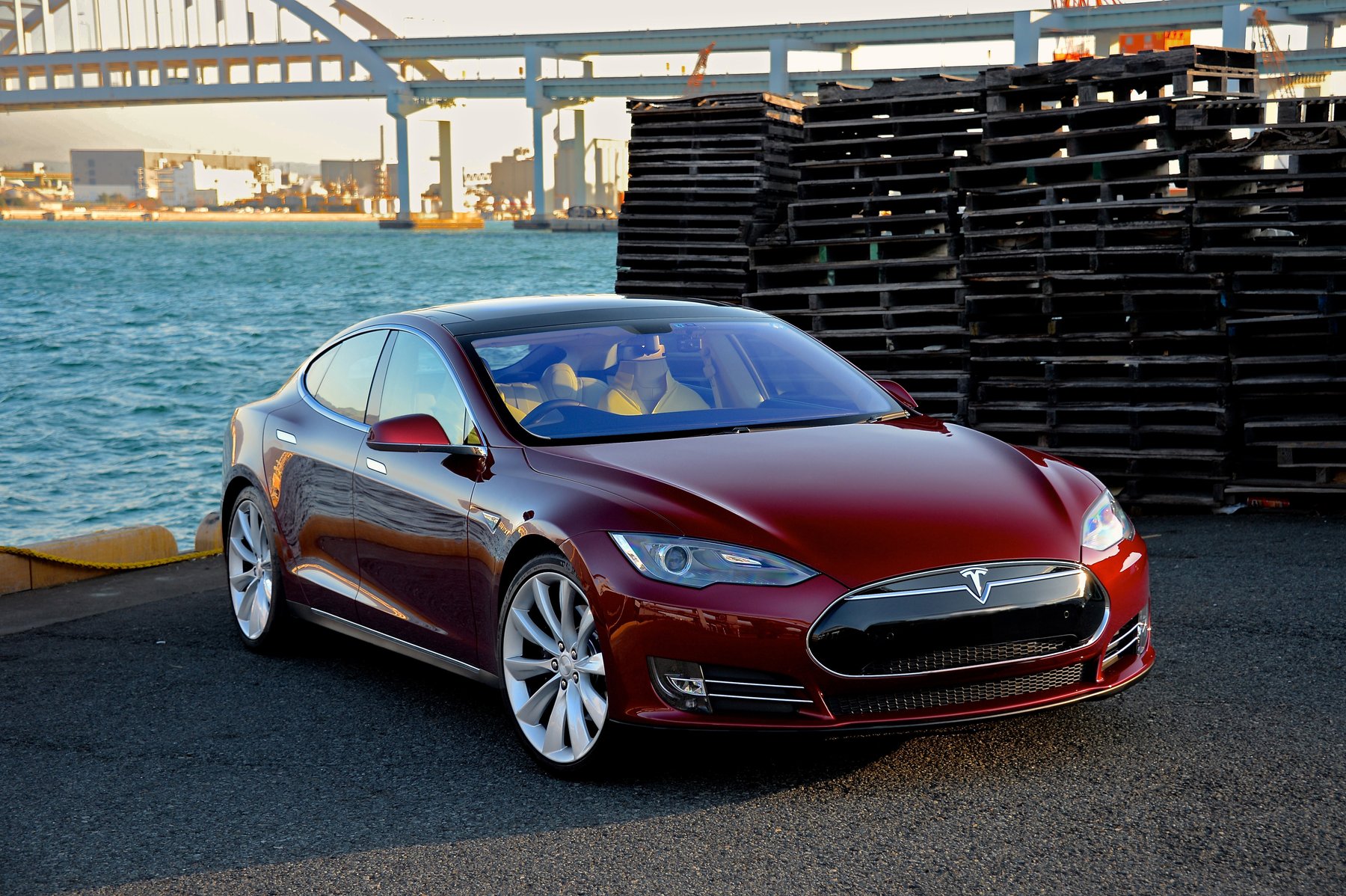
A Tesla keeps changing after it's built. An update lands overnight and the car in your driveway
has a new trick. Trim names come and go, range figures move, and a 2021 isn't the same car as a
2024 wearing the same badge. This is where to sort it out: every model from the 2008 Roadster to
the Cybertruck and Semi, what changed in which year and how to spot it, EPA range by
configuration, NHTSA recalls, and the hidden features worth knowing about.
Martin Eberhard and Marc Tarpenning incorporate Tesla Motors on July 1, 2003, in San Carlos, California, and name it after the inventor Nikola Tesla. Eberhard is CEO and Tarpenning is CFO.
About 350 invited guests at Barker Hangar in Santa Monica get the first look at the Roadster on July 19, presented by chairman Elon Musk and CEO Martin Eberhard.
Musk publishes "The Secret Tesla Motors Master Plan (just between you and me)". The plan: build a sports car, use that money to build an affordable car, use that money to build an even more affordable car, and offer zero-emission power generation along the way.
The first production Roadster goes to Elon Musk. It rides on a heavily modified Lotus Elise chassis but shares only about 6 percent of its parts with the Elise, and it's the first highway-legal, series-production electric car to use lithium-ion cells. About 2,450 are built through 2012.
Tesla agrees to buy most of the shuttered NUMMI plant in Fremont, California, for $42 million, and Toyota agrees to buy $50 million of Tesla stock. Fremont becomes the home of the Model S.
Tesla lists on Nasdaq on June 29 at $17 a share and closes its first day at $23.89. The $226.1 million offering includes shares sold by existing stockholders; Tesla's own share, per the June 28 prospectus, is about $188.8 million in proceeds to Tesla after the underwriting discount and before expenses. Bloomberg calls it the first IPO of an American carmaker since Ford in 1956. These are 2010 dollars and 2010 share prices, from before any stock split.
Rounded to $0.1 million from the June 28, 2010 prospectus cover. Tesla and selling-stockholder proceeds are after the underwriting discount but before expenses. The additional-share option and Toyota private placement are excluded. This is a historical offering breakdown, not market capitalization.View full diagram ↗Original diagram: TeslaCarFacts. Sources:
Tesla June 28, 2010 prospectus, cover tableSource
The first customers collect their Model S sedans at the Fremont factory on June 22. That November, Motor Trend's judges unanimously name it the 2013 Car of the Year.
At its Hawthorne, California, design studio on September 24, Tesla unveils the Supercharger network and names its first six stations, each delivering close to 100 kW and free for Model S owners on long trips.
Tesla pays off its Department of Energy loan nine years early, wiring $451.8 million to cover principal, interest, and a $10.8 million early-repayment fee.
June 2014Tesla announces a conditional patent pledge
On June 12, Tesla pledges not to start patent lawsuits over electric-vehicle technology against anyone acting in good faith. There's fine print: the published terms set conditions about challenging Tesla's patents, bringing intellectual-property claims and selling knock-off products. Tesla calls the pledge a standstill on enforcement, not a patent license, so the patents weren't simply given away.
Construction begins in Storey County, east of Reno near Sparks, on Tesla's first battery Gigafactory, built with partner Panasonic. Tesla and Nevada officials announce the site publicly that September.
New Model S cars start leaving Fremont with a forward camera, radar, ultrasonic sensors, and a Mobileye EyeQ3 chip. The hardware sits mostly idle until the software catches up a year later, an early case of a Tesla getting better while parked in the driveway.
Software version 7.0 starts reaching cars over the air on October 14, turning on Autosteer (labeled beta), automatic lane changes, and Autopark for Model S cars built with the 2014 hardware.
Tesla says every car it now builds carries eight cameras, twelve ultrasonic sensors, a forward radar, and a far more powerful onboard computer, hardware it pitches as ready for full self-driving once the software arrives.
Tesla completes its roughly $2.6 billion purchase of SolarCity, the solar installer founded by Musk's cousins Lyndon and Peter Rive, after more than 85 percent of unaffiliated shareholders vote yes.
Serial number 1 rolls off the Fremont line on July 7 and goes to Musk. The first 30 customer cars, all for Tesla employees, are handed over at a party on July 28.
November 2017Semi unveiled, with a Roadster surprise
At a Hawthorne event on November 16, Tesla reveals the Semi with a quoted 500 miles of range at maximum weight, then springs a surprise: a second-generation Roadster it claims will reach 60 mph in 1.9 seconds.
Seven weeks after Musk tweeted that he had funding secured to take Tesla private at $420 a share, he and Tesla settle SEC charges on September 29. Each pays a $20 million penalty, and Musk gives up the chairman's seat for three years while staying CEO.
Tesla shows the stainless-steel Cybertruck in Hawthorne on November 21. The demo goes sideways when design chief Franz von Holzhausen throws a metal ball at the "Armor Glass" side windows and shatters both.
December 2019Gigafactory Shanghai delivers its first cars
Less than a year after breaking ground on January 7, Tesla hands over the first China-built Model 3 sedans on December 30. Shanghai is Tesla's first Gigafactory outside the United States and the first car plant in China wholly owned by a foreign company.
Tesla shows the 4680 cell, 46 mm across and 80 mm long with a tabless design, and claims five times the energy and six times the power of its previous cells.
On October 20, a small group of U.S. owners in Tesla's Early Access Program gets the Full Self-Driving Beta, a rewritten driver-assistance branch that still needs a supervising driver.
Non-Tesla EVs can charge at ten Dutch Supercharger stations starting November 1. By February 2022 the whole network in the Netherlands is open to them.
Musk hands the first 30 German-built Model Y SUVs to customers at the opening of Gigafactory Berlin-Brandenburg in Grünheide on March 22, with Chancellor Olaf Scholz in attendance.
Tesla publishes Master Plan Part 3, a white paper arguing that a sustainable global energy economy would take about $10 trillion in manufacturing investment, less than projected spending on fossil fuels.
Ford agrees on May 25 to adopt Tesla's plug and gain Supercharger access. GM follows in June, other automakers pile in, and SAE International moves to standardize the connector as J3400, the North American Charging Standard (NACS).
February 2024Ford drivers join the Supercharger network
On February 29, Mustang Mach-E and F-150 Lightning owners gain access to more than 15,000 Superchargers in the U.S. and Canada with an adapter, the first automaker deal of its kind to go live. Rivian owners follow in March.
April 2024More than a tenth of the workforce is cut
In a memo to staff on April 15, Elon Musk says Tesla will cut more than 10 percent of its global workforce, which stood at 140,473 employees at the end of 2023. He cites duplicated roles and the need to cut costs.
At the end of April, Tesla lays off charging chief Rebecca Tinucci and substantially all of her roughly 500-person team. Musk says the network will keep growing, just at a slower pace.
June 2024Shareholders vote again on Musk's 2018 pay plan
On June 13, about 77 percent of votes cast back Musk's 2018 pay package, five months after a Delaware judge ordered it rescinded. The same meeting takes up a proposal to move Tesla's incorporation from Delaware to Texas.
On October 10 at the Warner Bros. studio lot in Los Angeles, Tesla shows the Cybercab, a two-seat robotaxi with no steering wheel or pedals, and the 20-passenger Robovan. Twenty concept Cybercabs give guests rides around the lot, and Musk says the car should cost under $30,000 with production in 2026.
Tesla delivers 1,789,226 vehicles in 2024, down from 1,808,581 in 2023. CNBC calls it the first annual drop in the company's history. Production for the year is 1,773,443.
The updated Model Y, code-named Juniper, goes on sale in China on January 10 from 263,500 yuan (about $35,950). Deliveries in China begin on February 26.
On June 22, Tesla starts paid robotaxi rides in a geofenced part of Austin, Texas, using Model Y cars with a safety monitor in the front passenger seat. The first riders are invited, and every trip costs a flat $4.20.
Tesla launches the Model Y L in China, a stretched six-seat Model Y with a 150 mm longer wheelbase and second-row captain's chairs, priced from 339,000 yuan.
On September 1, Tesla publishes Master Plan Part 4 on X, built around the idea of sustainable abundance through AI, autonomy, and the Optimus humanoid robot. Unlike the earlier plans, it names no specific products, numbers, or timelines.
October 2025A record quarter as the tax credit ends
Tesla reports 497,099 deliveries for the third quarter of 2025, the most in any quarter in its history, as U.S. buyers rush to claim the $7,500 federal EV tax credit before it ends on September 30.
On October 7, Tesla adds lower-priced Standard versions of its two best sellers: the Model 3 Standard at $36,990 and the rear-wheel-drive Model Y Standard at $39,990, following the end of the U.S. federal EV tax credit.
November 2025Shareholders approve the 2025 CEO award
At the annual meeting in Austin on November 6, more than 75 percent of votes approve a performance award for Musk worth up to nearly $1 trillion. It pays out only if Tesla hits targets such as an $8.5 trillion market value and 20 million vehicles delivered.
December 2025Delaware restores Musk's 2018 pay plan
On December 19, the Delaware Supreme Court reinstates the 2018 pay package that a lower court voided in 2024, reasoning that canceling it left Musk unpaid for six years of work. The shareholder who sued gets $1 in nominal damages.
Tesla delivers 1,636,129 vehicles in 2025, about 9 percent fewer than in 2024 and its second straight annual decline. BYD sells more battery-electric cars than Tesla over the year for the first time.
On January 22, some Austin robotaxi riders are picked up by a Model Y with no one else in the car. The driverless cars are mixed into a fleet that still mostly carries safety monitors.
Tesla's fourth-quarter report, released January 28, discloses a $2 billion investment in xAI, Musk's artificial-intelligence company. Tesla says it bought in on the same terms as the round's other investors.
On February 17, the first Cybercab rolls off the production line at Gigafactory Texas. Volume production begins in April, with Musk warning that output will start very slowly before ramping.
April 2026First European approval for FSD (Supervised)
On April 10, the Dutch vehicle authority RDW grants Full Self-Driving (Supervised) a provisional national type approval, the first in Europe. It's valid only in the Netherlands, and the driver still has to pay attention.
Tesla's robotaxi service arrives in Dallas and Houston in April, using Model Y cars and running at least some rides without a safety driver. Trackers count about one active car in each city at launch, against about 46 in Austin.
The final 350 cars, Signature editions of the Model S Plaid and Model X Plaid, come off the Fremont line in early May, ending a run that began with the first Model S deliveries in June 2012. Tesla holds a delivery ceremony on May 20.
At the start of July, Tesla launches the six-seat, three-row Model Y L in the United States. The Launch Series costs $61,990 with up to 325 miles of range, and deliveries are slated for September or October.
August 2026Terafab chip plant set for Grimes County
On August 6, Tesla and SpaceX say they're building Terafab, a chip plant in Grimes County, Texas, with $16.8 billion going into the first phase. It's meant to make, package and test the logic and memory chips for Optimus robots, Cybercabs and SpaceX's planned space-based data centers.
On September 3, the Cybercab, the two-seater with no steering wheel or pedals, starts carrying members of the public in Austin. By then Tesla's robotaxi service is also running in Dallas, Houston, Miami, Orlando and Tampa, but those cities get Model Ys.
On September 12, nearly nine years after the concept first appeared, Tesla says it will reveal the second-generation Roadster on October 1, 2026, at an event in Waco, Texas.
On September 24, at a rollout event at its Semi factory in Sparks, Nevada, Tesla says deliveries to its first volume customers, including PepsiCo, DHL and US Foods, are beginning. It doesn't announce a price. Two days earlier, a shipper alliance whose founders include Microsoft and PepsiCo had named Tesla the primary supplier on an order for 2,500 electric trucks.
On October 15, at McGregor, Texas, Tesla presents a redesigned Roadster prototype, almost nine years after the first one upstaged the Semi in Hawthorne.
On the October 21 earnings call, Musk says Tesla has "started what I'd call early production on a high-volume line in Fremont" for the Optimus robot. The line sits where the Model S and Model X were built until May.